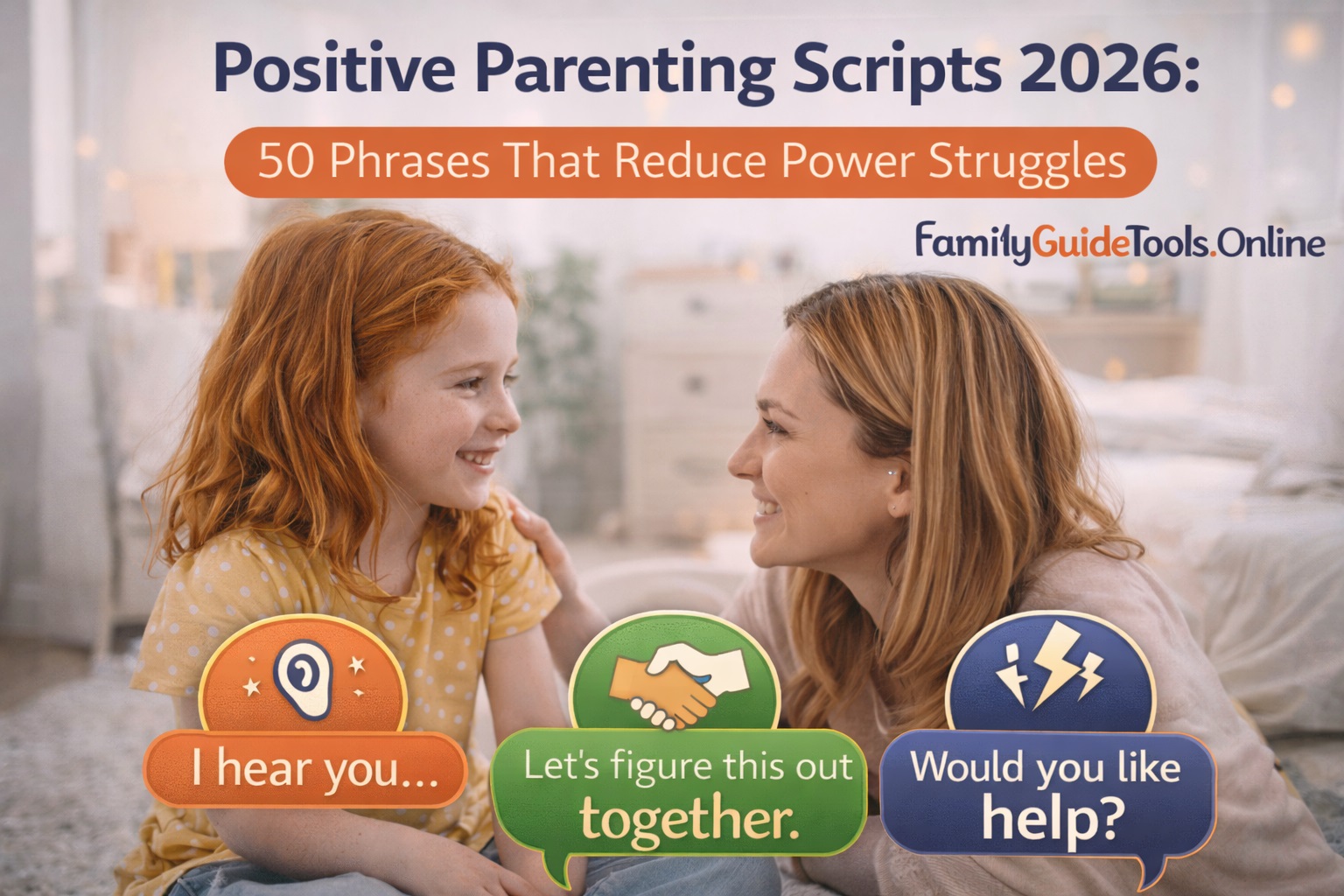
You know the moment: you ask your child to do something normal—put on shoes, turn off the tablet, brush teeth—and suddenly it turns into a full-blown battle. Your child says “NO!” You repeat yourself. They escalate. You escalate. Now it’s a power struggle and everyone loses.
Positive parenting doesn’t mean you never set limits. It means you set limits without turning every limit into a fight. One of the fastest ways to do that is by using scripts—simple phrases you can lean on when you’re tired, stressed, or running late.
This 2026 guide gives you 50 copy-and-use phrases that reduce power struggles while still keeping you in charge. You’ll also learn how to deliver them so they sound natural, what to do if your child ignores you, and how to repair after a tough moment.
Why “Scripts” Work When You’re Tired
Kids Borrow Your Calm
Children don’t regulate their emotions the way adults do. They borrow regulation from you—your tone, your body language, your pace. When your words are steady and predictable, your child’s nervous system calms faster.
Scripts help because they:
-
reduce long lectures
-
prevent reactive yelling
-
keep boundaries clear
-
make you more consistent (even when you’re drained)
Power Struggles Are Often “Need” Struggles
Many battles are not truly about socks, snacks, or screens. They’re about:
-
needing control
-
feeling rushed
-
being hungry or tired
-
wanting connection
-
feeling powerless
Scripts work because they acknowledge the feeling and hold the limit.
The 2026 Positive Parenting Mindset in One Minute
Connection Before Correction
Connection doesn’t mean “give in.” It means your child feels seen. When kids feel seen, they cooperate more.
A simple formula:
-
Notice the feeling
-
State the limit
-
Offer the next step
Firm + Kind at the Same Time
You can be warm and still be the leader. Kids feel safest when you’re both:
-
kind (respectful, calm)
-
firm (clear, consistent)
How to Use These Scripts Without Sounding Fake
Tone, Timing, and Body Language
The same words can work—or fail—depending on delivery.
Do this:
-
get close (kneel or lean in)
-
speak slower than usual
-
use fewer words
-
neutral face + soft eyes
-
gentle touch (if your child likes touch)
Avoid:
-
shouting across the room
-
repeating the same sentence 10 times
-
negotiating when the limit is non-negotiable
What to Do If Your Child Laughs or Ignores You
Some kids laugh when nervous. Some ignore to test. Don’t take it personally.
Try:
-
repeat once (same words, calmer tone)
-
then act: guide hands, move the item, start the routine
-
keep it boring (no big emotional reaction)
Calm follow-through is the secret sauce.
50 Positive Parenting Phrases That Reduce Power Struggles
Use these like a menu. Pick a few that match your style, then repeat them often so your child recognizes them.
Scripts for Transitions (Leaving, Bedtime, Cleanup)
-
“In two minutes, we’re switching.”
-
“First ___, then ___.”
-
“Do you want to hop like a bunny or walk like a robot to the car?”
-
“I’ll help you start. You can finish.”
-
“It’s hard to stop when you’re having fun. We’re still leaving.”
-
“Let’s do a ‘one last thing’ and then we go.”
-
“When the timer beeps, we move our body.”
-
“I’m going to count down from 5, then we begin.”
-
“Cleanup is part of play. I’m here with you.”
-
“We can be upset and still do the next step.”
Scripts for “No” Without a Fight (Firm Limits)
-
“I won’t let you.”
-
“Not right now.”
-
“That’s not available today.”
-
“You really want that. The answer is still no.”
-
“I hear you. The limit stays.”
-
“I’m deciding this because it’s my job to keep you safe.”
-
“I’m not changing my mind. You can be mad.”
-
“I won’t argue about this.”
-
“We can try again tomorrow.”
-
“You can choose between these two options.”
Scripts for Tantrums and Big Feelings
-
“You’re having a big feeling. I’m right here.”
-
“It’s okay to cry. I’ll stay close.”
-
“I won’t let you hurt yourself or me.”
-
“When your body is ready, we’ll talk.”
-
“Breathe with me—slow in, slow out.”
-
“Tell me with words, not screams. I’m listening.”
-
“This is hard. We’ll get through it together.”
-
“Your feelings are welcome. Your behavior has limits.”
-
“I’m going to keep you safe while you’re upset.”
-
“We can solve the problem after the storm.”
Scripts for Hitting, Biting, and Aggression
-
“I won’t let you hit.”
-
“Hands are for helping, not hurting.”
-
“I’m moving my body back to stay safe.”
-
“You can be angry, and you can stomp—no hitting.”
-
“I’m going to hold your hands to keep everyone safe.”
-
“Show me ‘gentle hands’.”
-
“If you need to bite, bite this (chewy/toy). Not people.”
-
“You wanted the toy. Hitting doesn’t work. Try: ‘Can I have a turn?’”
-
“We take a break until your body is calm.”
-
“I know you’re upset. I’m still not letting you hurt.”
Scripts for Sibling Conflict
-
“I won’t choose sides. I will help you solve it.”
-
“Both of you want it. What’s a fair plan?”
-
“Let’s do turns. Who goes first?”
-
“I’m hearing two different stories. We can still fix it.”
-
“I will not let you hurt each other. I’m stepping in.”
Scripts for Whining and Negotiation
-
“Try again in a normal voice.”
-
“I can understand you when your voice is calm.”
-
“I’m not saying yes to whining.”
-
“You can ask once. If the answer is no, we stop.”
-
“I’m done discussing it. Let’s move on.”
Pro tip: Save your top 10 phrases in your phone notes. The goal isn’t to memorize all 50. It’s to have a small set you use consistently.
Mini Examples: Same Script, Different Ages
Toddlers (1–3)
Toddlers need fewer words and more action.
-
Script: “First shoes, then park.”
-
Do: show shoes, point to door, help start
-
-
Script: “I won’t let you hit.”
-
Do: block gently, hold hands, move away
-
Preschool (3–5)
Preschoolers can handle simple choices and short reasons.
-
Script: “You can be mad and still do the next step.”
-
Do: “Brush teeth, then book.”
-
-
Script: “Choose: red cup or blue cup.”
-
Do: hold up choices, then follow through
-
Early School Age (6–9)
School-age kids respond well to collaboration—but still need limits.
-
Script: “I hear you. The limit stays.”
-
Do: “Tell me your idea for tomorrow.”
-
-
Script: “We can solve the problem after the storm.”
-
Do: calm first, then problem-solve together
-
Common Mistakes That Make Scripts Backfire
Too Many Words
When you lecture, kids stop listening. Also, long explanations can sound like negotiation.
Better:
-
one sentence
-
then action
-
then repeat calmly if needed
Instead of:
“Because I said so and you always do this and we’re late…”
Try:
“We’re leaving now. Shoes on.”
Asking Questions You Don’t Mean
If it’s not a real choice, don’t phrase it like one.
Not great: “Do you want to stop watching?”
Better: “Screen time is done. Do you want to turn it off or should I?”
Quick Reset If You Lost Your Cool
You’re human. You will mess up sometimes. The magic is repair.
Repair Phrases That Rebuild Trust
Use these after a tough moment:
-
“I didn’t like how I spoke. I’m sorry.”
-
“You didn’t deserve yelling. I’m practicing staying calm.”
-
“Let’s try that again. I’ll use a kinder voice.”
-
“We’re on the same team. I’m here.”
-
“I can be firm and kind. I’m working on it.”
Repairs teach kids accountability, emotional maturity, and how to reconnect after conflict.
FAQs About Positive Parenting Scripts
1) Are scripts just “gentle parenting” that lets kids win?
No. Good scripts hold boundaries. They reduce power struggles by keeping you calm and consistent, not by giving in.
2) What if my child keeps doing the behavior anyway?
Scripts are step one. Step two is follow-through. Say it once or twice, then act calmly: guide, remove, pause, or reset the routine.
3) Will scripts work for strong-willed kids?
Yes, especially when paired with:
-
clear choices
-
predictable routines
-
fewer words
-
consistent follow-through
Strong-willed kids often need clearer leadership, not harsher punishment.
4) How long until I see results?
Often you’ll see small improvements within days, but real change takes repetition. Pick 5–10 phrases and use them consistently for 2–3 weeks.
5) What’s the fastest way to stop power struggles?
Stop arguing. Offer two choices or a clear next step, then follow through calmly.
Final Thoughts: Consistency Beats Perfection
Positive parenting scripts are not magic spells. They are tools—simple language that keeps you steady, reduces drama, and helps your child feel safe while you hold the boundary.
Start small:
-
choose 10 phrases
-
put them on a note
-
repeat them daily
-
follow through calmly
Over time, your child learns: you mean what you say—and you can be trusted.
Helpful references:
American Academy of Pediatrics (HealthyChildren.org) – Guidance on behavior & discipline:
https://www.healthychildren.org/English/family-life/family-dynamics/communication-discipline/Pages/default.aspx
CDC “Essentials for Parenting Toddlers and Preschoolers”:
https://www.cdc.gov/parents/essentials/index.html
Zero to Three – Toddler behavior and development:
https://www.zerotothree.org/
Harvard Center on the Developing Child – Self-regulation & responsive relationships:
https://developingchild.harvard.edu/