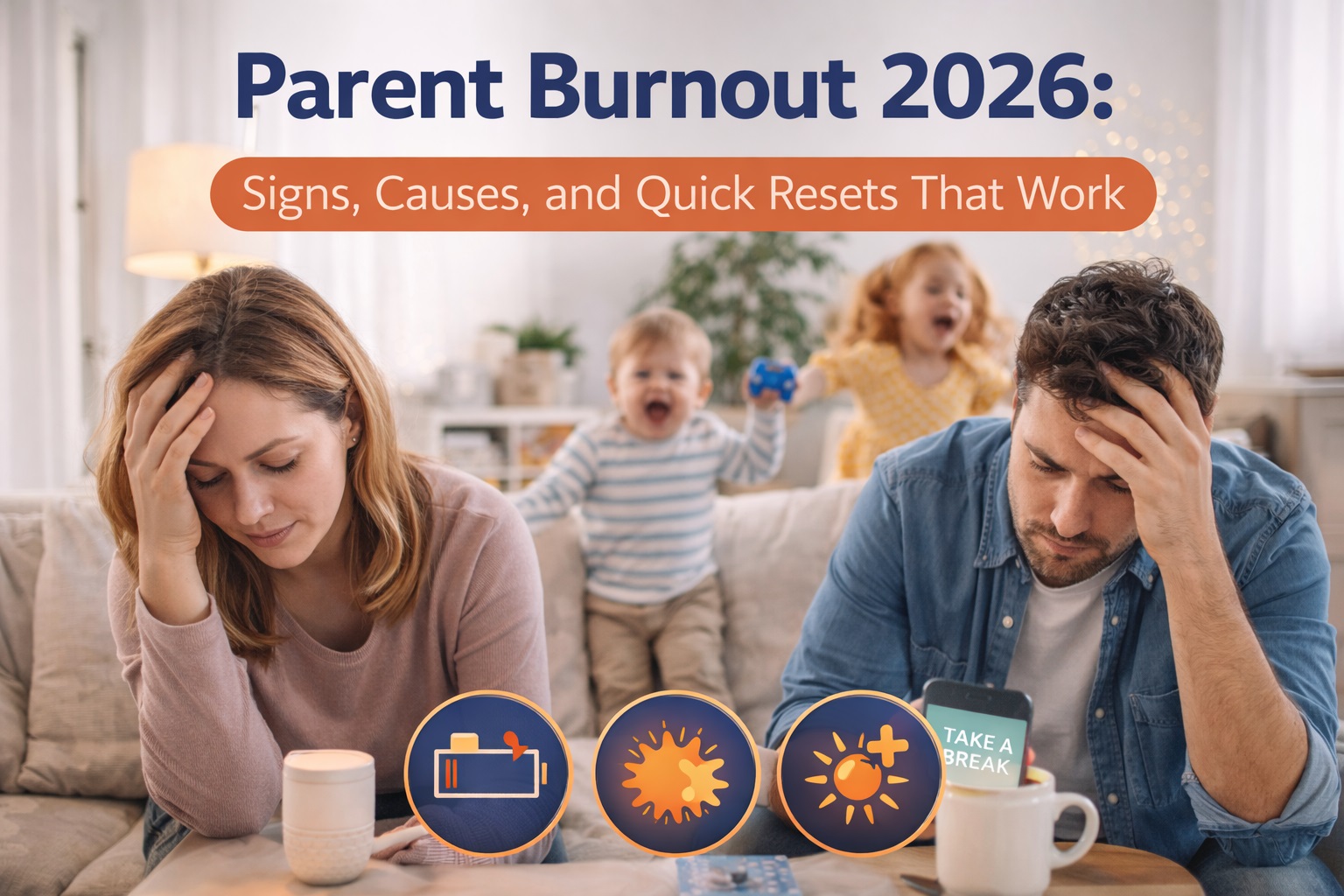
Parenting can be beautiful, meaningful, and deeply loving. It can also be loud, messy, repetitive, and exhausting. And here’s the thing: if the stress doesn’t let up, parent burnout can show up quietly—until it doesn’t feel quiet anymore.
In 2026, many parents are carrying more than “just” parenting. Work messages don’t stop. School demands change fast. Costs are high. Support can be thin. Expectations are sky-high. If you’ve been thinking, “Why can’t I handle what other parents handle?”—please hear this: parent burnout is not a character flaw. It’s often a load problem, not a “you” problem.
This guide will help you spot parent burnout, understand what causes parent burnout, and use quick resets that actually help—without requiring a perfect routine or a magical free weekend.
1) What Parent Burnout Really Is (and What It Isn’t)
Parent burnout is more than being tired. It’s what can happen when parenting stress becomes chronic—and your recovery time becomes too small to refill the tank.
The difference between “tired” and parent burnout
Most parents are tired sometimes. In normal tiredness, rest helps. A nap, a calmer day, or a supportive talk can bring you back.
With parent burnout, you can rest and still feel empty. You may feel like your patience is “gone,” your emotions are flat, or your brain is always buzzing. Your body keeps pushing the same message: I can’t keep doing this at this pace.
Burnout vs. depression vs. anxiety
This part matters because the right support depends on what’s happening.
-
Parent burnout often includes deep exhaustion, emotional distancing, and feeling ineffective as a parent. Research describes parental burnout as an exhaustion syndrome tied to chronic stress in the parenting role. SAGE Journals+1
-
Depression often includes persistent sadness or loss of interest plus other symptoms that can show up in many areas of life—not just parenting.
-
Anxiety often shows up as constant worry, racing thoughts, tension, and “what if” spirals.
They can overlap. You can have parent burnout and anxiety, or parent burnout and depression. If you’re unsure, professional support can help you sort it out.
Why parent burnout has become louder in 2026
Many families are dealing with a mismatch: demands rising faster than resources. That mismatch is a major theme in parental burnout research (demands outweigh support, time, energy, and coping capacity). Wiley Online Library+1
Also, modern parenting can be “always visible.” Social feeds show highlight reels, and it’s easy to feel behind—even when you’re doing a lot.
The 3 classic burnout dimensions (and why parenting needs its own lens)
The World Health Organization describes burnout in the workplace as a syndrome from chronic, unmanaged stress, with three dimensions: exhaustion, mental distance/cynicism, and reduced efficacy. World Health Organization
Parenting is not a job in the official sense—but those dimensions can feel familiar when parent burnout hits: exhaustion, emotional distance, and that painful thought: “I’m not doing a good job.”
Key idea: Parent burnout often improves when the system changes—not just when you “try harder.”
2) 9 Powerful Signs You Might Be in Parent Burnout
If you see yourself in these, don’t panic. Use them as information. Parent burnout is a signal that your current setup needs support.
Sign 1: You wake up already drained
Not “sleepy.” Drained. Like the battery is at 10% before the day even starts. That’s a classic parent burnout clue.
Sign 2: Small things feel huge
Spilled milk feels like a disaster. A child whining feels unbearable. Your nervous system is overworked, so tiny stressors hit like big ones.
Sign 3: You feel emotionally “numb”
Some parents describe parent burnout as feeling flat: fewer tears, less joy, less excitement—just autopilot.
Sign 4: Irritability spikes (even with people you love)
You’re not “mean.” You’re depleted. Parent burnout can shrink your patience and raise your reactivity.
Sign 5: You “check out” more than you want to
Scrolling longer than you planned. Zoning out. Avoiding play. This can be your brain’s attempt to protect you when parent burnout is high.
Sign 6: Sleep is broken or never refreshing
Even if you get hours, your body may not feel restored. Stress can keep the system on high alert, which feeds parent burnout again.
Sign 7: You feel guilt, shame, or “I’m failing” thoughts
Guilt is common in parent burnout—especially when you care deeply. But guilt is not proof you’re doing a bad job. Often it’s proof you’re carrying too much.
Sign 8: You’ve lost your sense of joy and play
Play is a sign of safety. When parent burnout rises, play often disappears first.
Sign 9: Your body keeps sounding alarms
Tension headaches, jaw clenching, shoulder tightness, stomach issues, frequent colds—your body can become the “messenger” for parent burnout.
Quick self-check (fast and honest)
Question If “Yes,” note it Do I feel chronically exhausted as a parent? ☐ Do I feel emotionally distant more often than I want? ☐ Do I feel like I’m not a good enough parent—even when I’m trying hard? ☐ Do small stressors trigger big reactions lately? ☐ Do I have enough support and recovery time? ☐If you checked several boxes, you may be dealing with parent burnout. The goal isn’t to label yourself. The goal is to choose better support.
3) Causes of Parent Burnout (The Real Roots Most People Miss)
Parent burnout is rarely caused by one thing. It’s usually a pile-up: too many demands, not enough resources, for too long.
The “demand vs. resources” imbalance
A major research idea in parental burnout is the imbalance model: when parenting demands stay high and resources stay low, burnout risk rises. SAGE Journals+1
Resources include: sleep, time, money, childcare help, emotional support, realistic expectations, and health.
Demands include: work pressure, multiple kids, complex schedules, kids’ needs, relationship conflict, and constant household labor.
When the scale tips, parent burnout becomes more likely.
Mental load and decision fatigue
Mental load is the invisible job: remembering everything, planning everything, noticing everything. In parent burnout, mental load becomes a constant background “tab” in your brain. That tab drains energy.
A practical truth: you don’t need better willpower. You need fewer tabs.
Perfectionism and comparison
Perfectionism can look like:
-
“Good parents never lose it.”
-
“My kids must always be happy.”
-
“If I don’t do it, it won’t be done right.”
Social media comparison adds fuel. If you’re already in parent burnout, comparing your messy real life to someone’s edited highlight reel is like running on a sprained ankle.
Lack of sleep and constant interruptions
Sleep is not a luxury. It’s a biological need. Chronic sleep loss can amplify stress reactions and make parent burnout harder to climb out of.
Relationship strain and unequal labor
When one parent carries most of the invisible work, parent burnout can rise quickly. Even supportive partners can accidentally miss the mental load unless it’s clearly mapped out.
“Always on” work + parenting overlap
When work expectations spill into evenings and weekends, parents can lose recovery time. Parent burnout thrives when you never truly clock out.
Kids’ needs that require extra energy
Parents of children with medical needs, behavioral challenges, learning issues, or neurodivergence may face higher demands. That doesn’t mean burnout is inevitable. It means support must be stronger and more consistent.
Risk factors vs. protective factors
Increases parent burnout risk Protects against parent burnout Chronic sleep loss Reliable rest routines Low support Practical help + emotional support High perfectionism “Good enough” parenting mindset Unequal division of labor Clear, fair task ownership Financial strain Budget support + community resources Isolation Connection with other adultsIf you want one sentence to remember: parent burnout often improves when the load becomes shareable and the recovery becomes real.
4) Quick Resets That Work (Today, This Week, and Long-Term)
Let’s be realistic: you can’t “self-care” your way out of a broken system. But you can use resets to lower stress fast—then build changes that keep parent burnout from bouncing back.
The 10-minute reset: body-first calm
When parent burnout is high, thinking your way to calm can feel impossible. Start with the body:
-
60-second breathing: inhale 4, exhale 6, repeat 6 times.
-
Cold water reset: splash cool water on your face or hold something cool for 30–60 seconds.
-
Shoulder drop + unclench: relax jaw, drop shoulders, slow your speech.
-
Name the feeling: “I’m overwhelmed. This is parent burnout talking.” (Labeling can reduce intensity.)
CDC also lists simple stress coping strategies like breathing, stretching, journaling, and time outdoors. CDC+1
Why it works: It tells your nervous system, “We’re not in danger right now.”
The 30-minute reset: reduce demands fast
Pick one:
-
Do a “minimum viable evening.” Simple dinner, simple cleanup, early lights.
-
Cancel one non-urgent task. Yes, cancel it. Parent burnout loves over-scheduling.
-
Make tomorrow easier. Pack bags, set clothes, choose breakfast—remove decisions.
This isn’t laziness. It’s intelligent recovery.
The 24-hour reset: repair sleep + support
If parent burnout is intense, aim for a 24-hour plan:
-
Sleep protection: earlier bedtime, phone away 30 minutes before sleep, lighter evening chores.
-
One support ask: childcare swap, family help, or a friend visit.
-
One joy moment: 15 minutes of something that feels like “you.”
Even one protected night can shift your patience and clarity.
The 7-day reset: build repeatable systems
This is where parent burnout starts to truly loosen.
Day 1–2: Reduce
-
Remove one optional commitment.
-
Cut one “should” standard (example: perfect lunches).
Day 3–4: Share
-
Write the weekly load (kids, house, admin).
-
Assign ownership—not “help.” Ownership means one person fully handles a task end-to-end.
Day 5–6: Simplify
-
Create 3 default meals.
-
Create 2 default bedtime routines (weekday/weekend).
-
Create a “when I’m overwhelmed” plan: the same 3 steps each time.
Day 7: Restore
-
Add a tiny recovery ritual daily: tea, walk, prayer/meditation, a short workout, journaling—whatever fits.
Scripts for asking for help (without guilt)
If asking feels awkward, try scripts like these:
-
To your partner: “I’m hitting parent burnout. I need us to rebalance the load. Can you fully own bedtime 4 nights this week?”
-
To a friend: “Could we do a childcare swap for 2 hours this weekend? I’m running on empty.”
-
To family: “I don’t need advice—I need practical help. Can you take the kids Saturday morning?”
-
To yourself: “Needing help doesn’t mean I’m failing. It means I’m human.”
When to seek professional support
Consider professional help if:
-
Parent burnout lasts weeks and doesn’t improve with rest or support changes.
-
You feel persistently hopeless, panicky, or emotionally shut down.
-
You’re using alcohol, substances, or risky coping to get through.
-
You feel like you might harm yourself or someone else.
The APA notes parenting stress and parental burnout can be serious, and psychologists recommend strategies and support to manage it. American Psychological Association+1
If you ever feel in immediate danger, contact your local emergency number right away.
FAQs
1) Is parent burnout “normal” in 2026?
It’s common, but it shouldn’t be brushed off. Parent burnout is a sign that demands and support are out of balance—not that you’re weak.
2) How do I know if it’s parent burnout or just a rough week?
A rough week usually improves with a few good nights of sleep or a calmer schedule. Parent burnout tends to feel persistent: exhaustion + emotional distance + “I can’t do this” thoughts that stick around.
3) Can dads get parent burnout too?
Absolutely. Parent burnout can affect any caregiver—moms, dads, single parents, guardians, and grandparents raising kids.
4) What’s the fastest way to reduce parent burnout today?
Protect sleep tonight, remove one non-urgent task, and ask for one piece of practical help. Small changes can lower parent burnout faster than you’d expect.
5) Does self-care fix parent burnout?
Self-care helps, but parent burnout often needs system change, too—especially around workload sharing, boundaries, and consistent support.
6) Can parent burnout affect kids?
Yes. Chronic stress can affect patience, connection, and family mood. That’s why addressing parent burnout is an act of care for your kids, not selfishness. SAGE Journals+1
7) What if I don’t have help—no family, no childcare?
Then your plan must focus on micro-resets and reducing demands. Choose “good enough” routines, lower standards where possible, connect with one supportive person (even online), and explore community options (school resources, parent groups, local support services).
8) What should I say to myself when I’m overwhelmed?
Try: “This is parent burnout, not failure. I need support, not shame.” Saying it out loud can interrupt the spiral.
Conclusion: A calmer 2026 starts with a lighter load
If you’re in parent burnout, you don’t need a personality makeover. You need relief. You need real recovery time. You need support that’s practical—not just advice.
Start small:
-
One 10-minute body reset today
-
One demand removed this week
-
One clear support ask
-
One “good enough” standard you give yourself permission to keep
That’s not giving up. That’s how you come back.
References and Helpful External Resources
-
World Health Organization (burnout definition and dimensions): World Health Organization
-
American Psychological Association (parental burnout guidance): American Psychological Association+1
-
CDC stress management tips: CDC+1
-
Parental burnout research overview and risk factors: SAGE Journals+1
https://www.apa.org/topics/stress/parental-burnout
https://www.cdc.gov/mental-health/living-with/index.html https://www.who.int/standards/classifications/frequently-asked-questions/burn-out-an-occupational-phenomenon