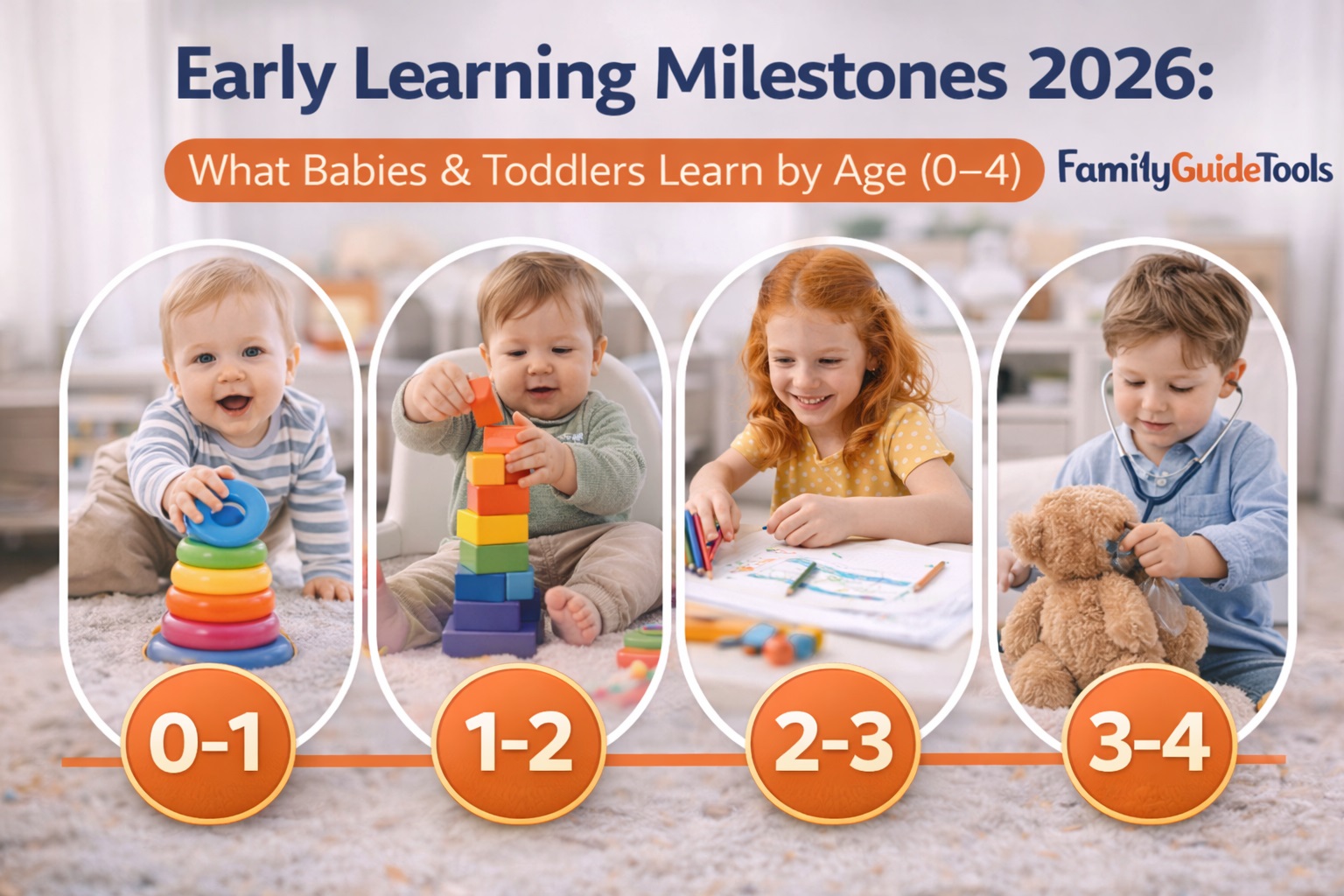
If you’ve ever wondered, “Is my child learning what they should?” you’re not alone. Babies and toddlers grow fast, and it can feel like everyone else’s child is suddenly talking in full sentences or counting to ten. However, early learning is not a race. It’s a steady build—one small skill stacking on another—until your child can communicate, move with confidence, and connect with the world in their own way.
This guide walks you through early learning milestones from birth to age four. You’ll learn what children typically pick up at each stage, how you can support them with simple everyday activities, and what signs may suggest it’s time to ask for extra help.
What “Early Learning” Really Means (And What It Doesn’t)
Learning Is More Than ABCs
Early learning includes how a child pays attention, copies you, remembers routines, solves problems, moves their body, and handles emotions. In other words, learning happens when your baby watches your face, when your toddler tries again after failing, and when your preschooler explains their drawing.
You don’t need fancy flashcards to build strong early learning. Instead, children learn best through:
-
warm relationships
-
play
-
repetition
-
real-life conversation
-
safe exploration
Why Milestones Are Guides, Not Grades
Milestones show what most children can do around certain ages. Still, children develop at different speeds. One child may speak early but walk later. Another may move nonstop but talk a bit later. That’s common.
Therefore, use milestones like a map, not a report card. If something feels off, you can act early—and early support often helps a lot.
How to Use This Milestone Guide as a Parent
Typical Range vs. Exact Age
You’ll see ages like “12–18 months.” That’s on purpose. Many skills develop in a range. Also, new skills can appear suddenly after weeks of practice.
The 4 Learning Areas to Watch
As you read, look for growth in these areas:
-
Language & Communication (sounds, words, understanding)
-
Cognitive Skills (thinking, problem-solving, memory)
-
Motor Skills (big movement + small hand skills)
-
Social-Emotional Skills (bonding, feelings, behavior)
Now, let’s go age by age.
Milestones From Birth to 6 Months
Brain, Attention, and Curiosity
In the first six months, babies learn through looking, listening, and feeling safe. You may notice they:
-
track faces and bright objects
-
stare at patterns
-
turn toward sounds
-
calm more easily with a familiar caregiver
They also start learning “patterns” like: when I cry, someone comes—a powerful lesson in trust.
Early Language Building Blocks
Even before words, babies build communication skills. They may:
-
coo and make vowel sounds
-
react to your voice (especially a soothing tone)
-
pause when you talk, as if “answering”
Try this: talk slowly, then pause. That pause teaches conversation rhythm.
Movement and Body Control
Early motor skills include:
-
lifting head during tummy time
-
bringing hands to mouth
-
kicking legs and waving arms
-
beginning to roll (some babies do it early, others later)
Movement is not just physical—movement drives brain growth because babies learn through their body.
Social-Emotional Growth
Your baby may:
-
smile socially
-
relax when held
-
enjoy eye contact
-
show discomfort with loud noises
The main milestone here is bonding. When you respond consistently, your baby learns safety—which supports learning later.
Milestones From 6 to 12 Months
Cause-and-Effect Learning
This is the fun stage where babies become little scientists. They learn:
-
if I drop it, it falls
-
if I shake it, it makes noise
-
if I bang it, it changes sound
You might also see “repetition experiments,” like dropping the spoon 50 times. It’s not misbehavior—it’s learning.
Babbling, Gestures, and Meaning
Many babies:
-
babble with consonants (ba-ba, da-da)
-
respond to their name
-
use gestures like reaching, waving, or pointing soon after
-
understand simple words like “no,” “bye,” or “milk” (varies by child)
Gestures matter because they are early communication tools. Pointing especially supports language growth later.
Sitting, Crawling, and Exploring
Motor milestones often include:
-
sitting without support
-
crawling or scooting (some skip crawling and go straight to walking)
-
pulling to stand
-
cruising along furniture
As movement increases, so does curiosity. Babyproofing becomes learning support.
Bonds, Stranger Anxiety, and Trust
Many babies show:
-
preference for familiar caregivers
-
stranger anxiety or separation anxiety
-
stronger reactions to tone (they notice if you sound upset)
This is emotional learning: babies start recognizing who is “safe” and how people respond.
Milestones From 12 to 18 Months
First Words and Understanding
Some toddlers say first words earlier, some later, but many begin to:
-
say a few meaningful words (mama, dada, ball, more)
-
understand more than they can say
-
follow simple one-step directions like “bring it” or “sit down”
A key milestone is understanding. Even if speech is limited, comprehension can be strong.
Problem-Solving Through Play
Toddlers often learn to:
-
try different ways to get a toy
-
fit basic shapes (not perfectly, but with effort)
-
copy your actions (pretend phone, brushing hair)
-
test boundaries to see what happens
This is early reasoning. Curiosity and repetition are their teachers.
Walking and Fine Motor Skills
You may see:
-
walking (wobbly at first)
-
climbing stairs with help
-
stacking a couple blocks
-
turning pages (sometimes several at once)
-
using finger and thumb “pincer” grasp well
Fine motor skills support feeding, play, and later writing.
Big Feelings Begin
Many toddlers:
-
get frustrated quickly
-
cry when they can’t communicate
-
want independence but still need help
-
begin to show preferences strongly (“no!”)
This is normal. They are learning emotional control, but they don’t have the skill yet.
Milestones From 18 to 24 Months
Word Burst and Two-Word Phrases
This stage often includes a language “jump.” Many toddlers:
-
add lots of new words over time
-
start combining words (“more milk,” “go car,” “mama up”)
-
point to body parts when asked
-
understand simple questions
If your toddler is not speaking much yet, focus on interaction and gesture use, and talk to your pediatrician if you’re concerned.
Imitation, Pretend Play, and Memory
Toddlers may:
-
pretend feed a doll
-
copy household actions
-
remember routines (“bath then book”)
-
search for hidden objects more effectively
Pretend play is a major cognitive milestone. It shows the child can hold an idea in their mind.
Independence and Boundaries
You’ll likely see:
-
wanting to do things “by myself”
-
refusing help sometimes
-
testing limits (throwing, yelling, running away)
Although it’s exhausting, boundary-testing is learning. Your calm consistency teaches rules.
Early Social Skills
Many toddlers:
-
watch other children closely
-
play next to kids (parallel play)
-
show affection in simple ways
-
struggle with sharing (very normal at this age)
Sharing is not a realistic expectation yet. Taking turns with support is a better goal.
Milestones From 2 to 3 Years
Language Leaps: Questions and Stories
Ages 2–3 often bring:
-
longer sentences
-
lots of “what” and “why”
-
naming feelings (“sad,” “mad”)
-
enjoying simple stories and songs
Tip: when your child asks “why,” they may be asking for connection, not a scientific explanation. Short answers work.
Early Math and Sorting Skills
Without “teaching math,” your child may:
-
sort by color or shape
-
understand “big/little”
-
count a few numbers (sometimes like a song)
-
match objects (sock pairs, lids to containers)
Everyday sorting is real learning.
Self-Help Skills and Routines
Many toddlers learn to:
-
wash hands with help
-
feed themselves more neatly
-
help with dressing (push arms through sleeves)
-
follow simple routines (clean up toys with guidance)
Routines reduce stress and improve behavior because the child knows what comes next.
Emotions, Empathy, and Sharing
You may notice:
-
stronger tantrums (because feelings are big)
-
beginning empathy (patting someone who cries)
-
some cooperative play moments
-
needing help to calm down
Co-regulation is key here. When you help them calm down, they slowly learn to do it themselves.
Milestones From 3 to 4 Years
Preschool-Style Learning at Home
At 3–4, children can often:
-
follow 2–3 step directions
-
play longer in one activity
-
ask more detailed questions
-
explain simple events (“we went park”)
They also learn through imaginative play—building, pretending, and role-playing.
Pre-Reading and Pre-Writing Skills
Many preschoolers:
-
recognize some letters (especially in their name)
-
enjoy rhymes and repeating books
-
hold crayons with better control
-
draw basic shapes or people (varies widely)
Pre-reading is not about reading early. It’s about loving stories, noticing print, and hearing sounds in language.
Stronger Self-Regulation
You may see improvement in:
-
waiting short turns
-
handling “no” with fewer meltdowns (not always!)
-
using words instead of hitting more often
-
choosing from options (“red shirt or blue?”)
Self-regulation grows with practice and your calm guidance.
Social Confidence and Friendship Skills
Many children start to:
-
play with kids (not only beside them)
-
show “best friend” preferences
-
practice teamwork in games
-
understand simple rules
If your child is shy, that can be normal too. Social confidence builds through safe exposure, not pressure.
Simple Activities That Support Every Age
10-Minute “Micro-Learning” Ideas
You don’t need an hour. Ten minutes done often can be powerful.
-
0–12 months: talk during feeding, mirror play, sing, peekaboo
-
12–24 months: name objects, point-and-label books, simple stacking, water play
-
2–3 years: sorting laundry by color, pretend cooking, “find the circle,” obstacle courses
-
3–4 years: story retelling, scavenger hunts, simple board games, drawing feelings
Also, involve your child in real tasks. Kids learn best when they feel included.
Screen Time That Doesn’t Replace Play
Screens can be part of life, but they shouldn’t replace:
-
active play
-
conversation
-
outdoor movement
-
hands-on exploration
If you use screens, watch together and talk about what you see. Interaction turns passive viewing into learning support.
When to Worry: Red Flags by Age
This section is not meant to scare you. It’s meant to help you act early if needed.
Speech and Communication Red Flags
Consider asking a professional if your child:
-
rarely makes sounds or doesn’t respond to voices (infant)
-
doesn’t babble by around 9–10 months
-
doesn’t use gestures like pointing/waving by around 12–18 months
-
doesn’t use meaningful words by around 16–18 months
-
loses words they previously used
Movement and Play Red Flags
Check in if your child:
-
feels very stiff or very floppy (infant)
-
isn’t making progress in movement over time
-
avoids using one side of the body
-
struggles to explore their environment at all
Social-Emotional Red Flags
Ask for support if your child:
-
rarely makes eye contact
-
doesn’t show interest in people
-
seems extremely distressed most of the time
-
doesn’t engage in any pretend play by age 3–4 (with consideration for differences)
If you’re unsure, it’s okay to ask. Getting an opinion does not label your child—it supports them.
How to Talk to a Pediatrician or Early Intervention
What to Track Before You Go
Before an appointment, write:
-
what your child does well
-
what you’re concerned about
-
when you first noticed it
-
examples (short notes help)
Also, note hearing, sleep, and screen habits because these can affect learning and speech.
Questions to Ask
-
“Is this within a typical range?”
-
“Should we check hearing?”
-
“Should we do a speech evaluation?”
-
“What can we do at home for 8 weeks and reassess?”
Early support often works best when it’s consistent and simple.
FAQs About Early Learning Milestones 2026
1) What if my child is ahead in one area but behind in another?
That’s common. Many children develop unevenly. Keep supporting growth, and ask for help if a gap feels large or stressful.
2) Is it bad if my toddler isn’t interested in letters yet?
Not at all. Love of books, conversation, and play builds the foundation. Letters can come later.
3) Do “educational toys” really matter?
Not as much as people think. A box, spoon, blocks, and pretend play can teach more than expensive toys—because your child uses imagination.
4) How can I support language if my child talks late?
Talk slowly, label things, read picture books, use gestures, and respond to attempts to communicate. Also, consider a hearing check and a professional evaluation if concerns persist.
5) What matters more: worksheets or play?
Play wins for ages 0–4. Play builds attention, language, problem-solving, and emotional control—skills that later make school easier.
Final Thoughts: Progress Over Perfection
Early learning in 2026 still comes down to the basics: a caring adult, a safe environment, and lots of everyday interaction. If you talk with your child, play with them, and give them chances to try, fail, and try again, you are doing something powerful.
Celebrate small progress. Keep routines simple. And if you ever feel worried, reach out early—support is a strength, not a judgment.
Helpful references:
CDC Developmental Milestones: https://www.cdc.gov/ncbddd/actearly/milestones/
American Academy of Pediatrics (HealthyChildren): https://www.healthychildren.org/
World Health Organization (Early child development): https://www.who.int/health-topics/early-child-development
UNICEF (Early childhood development): https://www.unicef.org/early-childhood-development
ZERO TO THREE (Development & behavior): https://www.zerotothree.org/