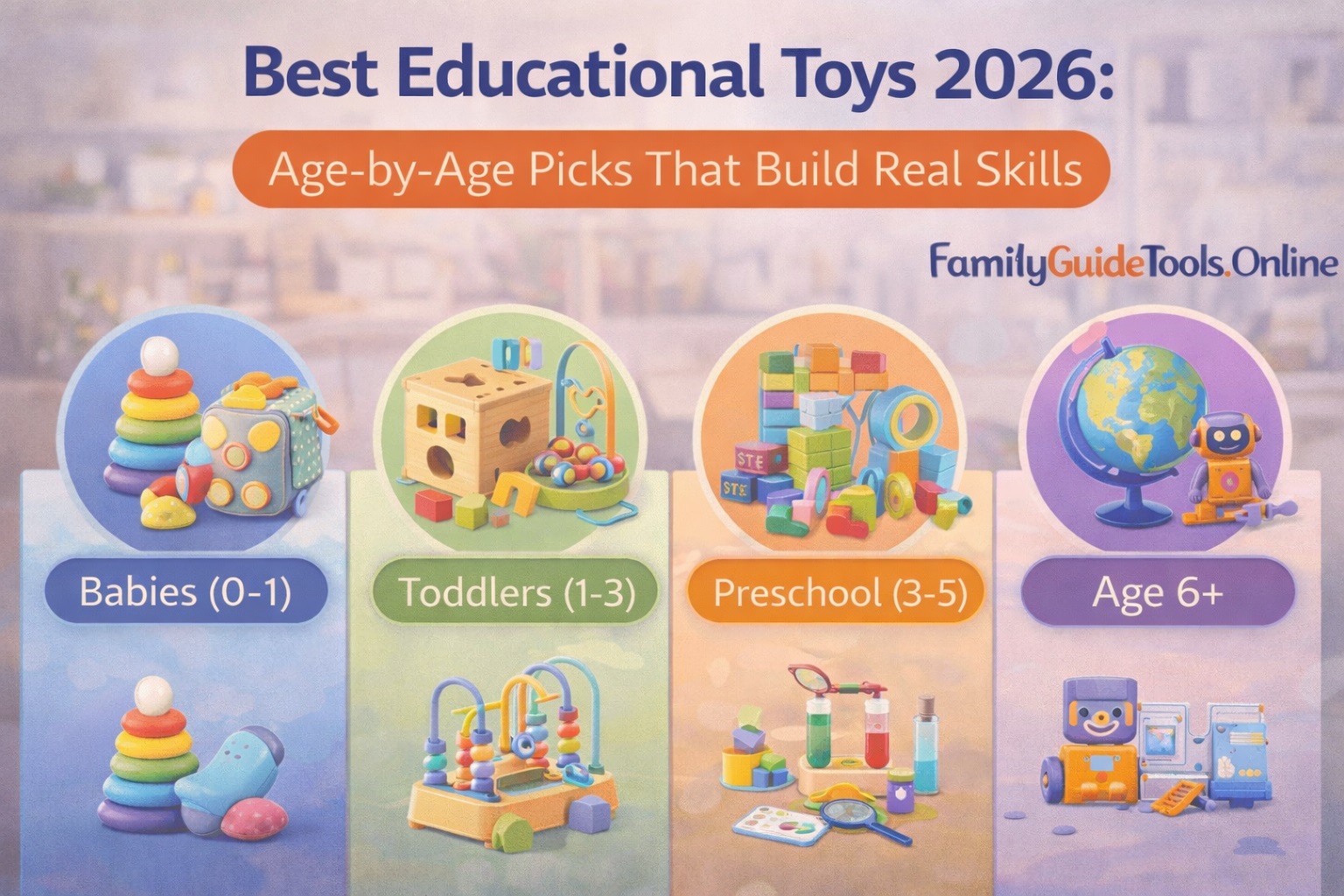
When parents search for “educational toys,” they usually mean one of two things:
-
“I want my child to learn real skills through play.”
-
“I don’t want to waste money on toys that light up, sing, and then get ignored after two days.”
Good news: in 2026, we’re finally getting clearer about what actually helps kids learn. The “best educational toys” aren’t the flashiest ones. They’re the ones that support brain development the way kids naturally learn: through hands-on play, repetition, imagination, movement, and connection with you.
This guide gives you:
-
age-by-age toy picks (from newborn to age 6)
-
the skills each toy builds (language, fine motor, STEM, self-regulation, and more)
-
what to skip (proven money traps)
-
a budget-friendly way to build a great toy shelf without clutter
Let’s make toy shopping simpler and smarter.
What Makes a Toy “Educational” in 2026 (Without the Marketing)
A toy is educational when it helps a child practice skills they’ll use in real life—while the child feels like they’re “just playing.”
The 5 Skill Buckets That Matter Most
Most strong educational toys build one or more of these:
-
Language & Communication
-
back-and-forth interaction
-
vocabulary and storytelling
-
listening and following directions
-
-
Fine Motor Skills
-
grasping, pinching, stacking
-
hand strength and control
-
early writing readiness
-
-
Thinking & Problem-Solving (Cognitive Skills)
-
cause and effect
-
memory
-
sorting and patterns
-
early logic and planning
-
-
Social-Emotional Skills
-
coping with frustration
-
turn-taking
-
empathy
-
pretend play and role practice
-
-
Gross Motor Skills
-
crawling, climbing, balancing
-
coordination
-
body awareness
-
If a toy supports these skills, it’s “educational”—even if it’s as simple as blocks.
Open-Ended vs. “Press-a-Button” Toys
Open-ended toys can be used in many ways. Kids stay engaged longer because the toy grows with them.
Examples: blocks, pretend food, magnetic tiles, dolls, animal figures, play dough.
Press-a-button toys often do the “thinking” for the child. Kids may watch instead of create.
These aren’t automatically “bad,” but they’re rarely your best educational investment.
A quick rule:
-
If the toy entertains your child without your child doing much, it’s mostly entertainment.
-
If your child must touch, decide, try, and imagine, it’s usually educational.
Quick Safety Checklist Before You Buy Anything
Educational toys only help if they’re safe for your child’s age.
Choking Hazards and Age Labels
-
Follow age recommendations, especially under age 3.
-
Avoid small detachable parts for babies and young toddlers.
-
Inspect toys regularly—kids are excellent at breaking things in creative ways.
Sound, Paint, and Battery Compartments
-
Avoid toys that are extremely loud close to the face.
-
Choose reputable materials and finishes.
-
If it has batteries, the compartment should be secured (ideally with a screw).
How Many Toys Do Kids Actually Need?
Not many. Too many toys can reduce focus and increase overstimulation.
The Toy Rotation Trick
Instead of buying more, rotate:
-
Keep 6–10 toys out.
-
Store the rest.
-
Swap every 1–2 weeks.
Kids often “rediscover” old toys like they’re brand new.
One Toy, Many Skills
The best toys build multiple skills:
-
Blocks = fine motor + spatial skills + creativity + frustration tolerance
-
Pretend kitchen = language + math (counting) + social-emotional skills
-
Puzzles = problem-solving + patience + hand-eye coordination
Educational Toy Picks by Age
Below are “picks” as toy types (not brand-specific), so you can choose what fits your budget and your home.
0–3 Months: Gentle Sensory + Connection
At this stage, the brain is learning to focus, track, and feel safe.
Best toy picks:
-
High-contrast black-and-white cards
-
Builds: visual tracking, attention
-
-
Soft rattle with a simple sound
-
Builds: cause-and-effect, early grasp
-
-
Crinkle cloth
-
Builds: sensory exploration, hand discovery
-
-
Unbreakable baby mirror (for supervised play)
-
Builds: attention, social interest
-
-
Soft mobile (simple, not overstimulating)
-
Builds: focus and calming routines
-
Parent pro-tip: Your voice is the best educational tool right now. Narrate your day in short sentences.
3–6 Months: Hands, Mouth, and Cause-and-Effect
Babies start grabbing, bringing things to their mouth, and learning “I did that!”
Best toy picks:
-
Teether (easy to hold, multiple textures)
-
Builds: sensory regulation, grasp
-
-
Ring stacker (soft or lightweight)
-
Builds: hand control, early problem-solving
-
-
Textured balls (easy to grip)
-
Builds: grasp, hand-to-hand transfer
-
-
Tummy time play mat (simple)
-
Builds: neck strength, gross motor foundation
-
-
Cloth books with faces/objects
-
Builds: early language exposure, attention
-
What matters most: short play sessions, repeated often. Babies learn through repetition.
6–9 Months: Sitting, Banging, Dropping, Exploring
This is the “tiny scientist” stage. Dropping is learning.
Best toy picks:
-
Stacking cups
-
Builds: spatial skills, early math concepts (size)
-
-
Cause-and-effect toys (simple pop-up, push-and-release)
-
Builds: problem-solving, persistence
-
-
Soft blocks
-
Builds: stacking, fine motor
-
-
Ball ramp (chunky, safe pieces)
-
Builds: cause-and-effect, tracking
-
-
Board books (with real-life photos)
-
Builds: vocabulary, joint attention
-
Skill focus: learning how actions create results.
9–12 Months: Pulling Up, Cruising, Copying You
Babies start imitating. Imitation is a huge learning milestone.
Best toy picks:
-
Shape sorter (simple shapes, not too complex)
-
Builds: problem-solving, matching
-
-
Stacking rings (more challenging now)
-
Builds: sequencing, hand control
-
-
Push toy / sturdy walker wagon (stable)
-
Builds: gross motor, confidence
-
-
Object permanence box (drop-in toy)
-
Builds: memory, cause-and-effect
-
-
“Real world” items basket (wood spoon, silicone spatula, safe measuring cups)
-
Builds: sensory play, imitation, creativity
-
Parent pro-tip: Play “copy me” games—clap, tap, wave. It builds communication and attention.
12–18 Months: Toddlers on the Move (and into Everything)
This stage is about independence, movement, and first words.
Best toy picks:
-
Large chunky puzzles (knob puzzles)
-
Builds: problem-solving, fine motor
-
-
Mega blocks / large building bricks
-
Builds: hand strength, creativity
-
-
Pretend play starter set (tea set, pretend phone, pretend food)
-
Builds: language, social-emotional skills
-
-
Balls (different sizes)
-
Builds: coordination, gross motor
-
-
Simple musical instruments (drum, shaker)
-
Builds: rhythm, cause-and-effect, emotional release
-
Skill focus: movement + language explosion + frustration tolerance.
18–24 Months: “I Do It!” + Problem-Solving
Now toddlers want control. Great toys let them practice safely.
Best toy picks:
-
Simple train tracks (big pieces)
-
Builds: planning, spatial reasoning
-
-
Pretend kitchen tools (pots, pans, toy foods)
-
Builds: language, sequencing (first/then), life skills
-
-
Chunky lacing beads (large)
-
Builds: fine motor, bilateral coordination
-
-
Water play tools (cups, funnels)
-
Builds: STEM basics, attention, calming sensory play
-
-
Ride-on toy (stable)
-
Builds: gross motor, balance
-
Parent pro-tip: Toddlers love “real jobs.” A toy broom or small cloth can be more engaging than expensive toys.
2–3 Years: Language Leaps + Pretend Worlds
This is a golden age for pretend play and early logic.
Best toy picks:
-
Magnetic tiles (large, age-appropriate)
-
Builds: STEM, geometry, creativity
-
-
Play dough + basic tools
-
Builds: hand strength, creativity, calming regulation
-
-
Pretend doctor kit / tool kit
-
Builds: emotional processing, storytelling
-
-
Matching and sorting games (colors, shapes)
-
Builds: early math, categorization
-
-
Simple board games (turn-taking)
-
Builds: patience, social skills
-
Skill focus: imagination + language + “learning how to learn.”
3–4 Years: Pre-School Skills Through Play
Kids can follow multi-step play plans now.
Best toy picks:
-
Construction sets (bigger pieces, safe)
-
Builds: planning, engineering thinking
-
-
Dress-up clothes
-
Builds: storytelling, perspective-taking
-
-
Story cards / picture prompts
-
Builds: language, sequencing (beginning-middle-end)
-
-
Scissor skills kit (safe scissors + paper)
-
Builds: fine motor, hand strength
-
-
Balance bike or scooter (with safety gear)
-
Builds: coordination, confidence
-
Parent pro-tip: Ask open questions: “What happens next?” It turns play into language practice.
4–5 Years: Stronger Logic, Stronger Imagination
This age loves challenges and “projects.”
Best toy picks:
-
More advanced puzzles (24–60 pieces)
-
Builds: visual-spatial skills, persistence
-
-
Counting games (dice games, simple math play)
-
Builds: number sense
-
-
Beginner STEM kits (magnets, gears, ramps—simple)
-
Builds: experimentation
-
-
Art station basics (markers, tape, paper, glue stick)
-
Builds: creativity, planning
-
-
Pretend play sets with roles (shop, restaurant)
-
Builds: social skills, negotiation
-
Skill focus: planning + early academics through play.
5–6 Years: Kindergarten Readiness Through Hands-On Skills
Kids can handle rules, build complex structures, and explain ideas.
Best toy picks:
-
Building sets with instructions + free build
-
Builds: following directions, engineering thinking
-
-
Simple strategy games (age-appropriate)
-
Builds: executive function, flexible thinking
-
-
Early coding toys (screen-free) (sequencing cards, robot that follows arrows)
-
Builds: logic, sequencing
-
-
Science exploration tools (magnifying glass, nature kit)
-
Builds: observation, curiosity
-
-
Creative writing/drawing prompts
-
Builds: storytelling, pre-writing skills
-
Parent pro-tip: If your child explains what they built and how it works, that’s major learning.
Skill-Based “Best Of” Lists (When You Don’t Know What to Buy)
Best for Language
-
board books with real photos
-
pretend play sets (kitchen, doctor)
-
story cards / puppets
-
dolls/figures for storytelling
Why it works: Language grows fastest in back-and-forth play.
Best for Fine Motor
-
play dough
-
lacing beads
-
stickers + paper
-
crayons/markers
-
chunky puzzles
Why it works: Fine motor is practice + repetition, not “one perfect toy.”
Best for Problem-Solving & STEM
-
blocks
-
magnetic tiles
-
ramps/ball runs
-
shape sorters
-
simple gears/magnets
Why it works: STEM begins with experimenting and testing “what happens if…”
Best for Emotional Skills & Calm
-
sensory bin tools (rice, water beads alternatives, kinetic sand—age-safe)
-
play dough
-
pretend play for processing fears (doctor kit)
-
simple breathing games + calm corner basket (book + stuffed toy + sensory item)
Why it works: Kids regulate through sensory input and predictable routines.
Best for Gross Motor
-
balls
-
tunnels
-
balance bike/scooter
-
stepping stones
-
obstacle course items (pillows, tape lines)
Why it works: Movement supports brain development and sleep, too.
Toys That Look Educational But Usually Aren’t (Money Traps)
Overstimulating Electronics
If a toy flashes, sings, and talks nonstop, it may:
-
reduce attention span in some kids
-
shift play into passive watching
-
become annoying fast
If you buy one, choose:
-
volume control
-
simple cause-and-effect
-
short, calm responses (not constant noise)
Too-Specific Single-Purpose Kits
Some “educational kits” are used once and forgotten. Open-ended toys usually win because they grow with your child.
Budget Guide: Build a Strong Toy Shelf for Less
The “Starter 10” Minimal Toy Set
If you want a powerful toy shelf without clutter, aim for:
-
blocks (or large building bricks)
-
balls (2–3 sizes)
-
puzzles (age-appropriate)
-
pretend play starter (kitchen or doctor)
-
books (5–10 rotated)
-
art basics (crayons + paper)
-
sensory tool (play dough)
-
stacking cups/rings
-
animal figures or dolls
-
one gross motor item (tunnel or ride-on/balance item)
That’s enough for months of learning.
What to Buy Used Safely
Usually safe used (if clean and complete):
-
blocks
-
puzzles (check pieces)
-
books
-
dress-up clothes
-
dollhouse/figures
-
ride-on toys (check stability)
Avoid used if you can’t verify safety:
-
damaged battery toys
-
heavily chipped paint
-
anything recalled
-
baby items with small detachable parts for under-3 kids
FAQs About Educational Toys 2026
1) How many educational toys does my child need?
A small set of versatile toys is enough. Rotation matters more than quantity.
2) Are Montessori toys better?
Not automatically. Many “Montessori-style” toys are just open-ended toys with simple design. Focus on function, not labels.
3) What’s the best toy for a speech delay?
No single toy fixes speech. Still, toys that encourage interaction help: books, pretend play, puppets, and anything you can play together with back-and-forth language.
4) Do kids need STEM toys early?
STEM starts with blocks, ramps, water play, sorting, and curiosity. You don’t need expensive kits for toddlers.
5) What if my child ignores “educational” toys?
They may be too advanced, too boring, or too many are out at once. Try:
-
simplifying the play area
-
rotating toys
-
playing together for 5 minutes to “start the play”
Final Takeaway: The Best Educational Toy Is You + Play
In 2026, the best educational toys aren’t about flashing lights or “genius” claims. They’re about real skill practice:
-
hands building
-
brains solving
-
bodies moving
-
hearts learning to cope
-
language growing through connection
If you choose a few open-ended toys, rotate them, and play with your child for even 10 minutes a day, you’re already giving them the strongest learning environment.